What's the Difference Between a Fuse Box and a DB Board?
Post Details
Key Takeaways
- A fuse box and a distribution board (DB board) serve the same fundamental purpose but use completely different protection technology. One uses sacrificial fuses; the other uses resettable circuit breakers.
- Older fuse boxes are generally not suited to the electrical demands of modern Dubai homes. They lack RCD protection, react more slowly to faults, and can't be reset without replacing a physical component.
- A DB board, which is the standard in all new and recently renovated UAE properties, offers faster fault response, easier reset, and support for residual current devices (RCDs) that protect against electric shock.
- If your property still has a fuse-based system, or if your DB board hasn't been assessed in several years, a professional inspection is worth scheduling.
- Any upgrade from a fuse box to a DB board must be carried out by a DEWA-certified, licensed electrician.
Walk up to the electrical panel in your home and open the cover. What do you see inside? If you're in a property built within the last decade or two in Dubai, you'll most likely find a modern distribution board with a row of labelled switches. But in older buildings, particularly those constructed before the mid-2000s, you might find something quite different: a fuse box with ceramic or cartridge fuses instead of switchable breakers.
Both do the same job at a high level. They manage the incoming power supply and split it into circuits that serve different parts of the property. But how they protect those circuits is where the two systems part ways significantly.
So what's the actual difference, and why does it matter for your home in Dubai?
The Basic Distinction: Fuses Versus Circuit Breakers
Let's start simply.
A fuse box uses a sacrificial wire or cartridge that melts to stop power during an overload. A distribution box, or DB board, uses reusable circuit breakers and Residual Current Devices (RCDs). When a fault occurs in a DB board, the breaker trips to the off position but nothing is destroyed. You reset it by flipping the switch back up.
That single difference has fairly significant practical implications. When a fuse blows, you need to locate a replacement fuse, open the panel, and swap it out, often in the dark, in a cupboard, with the power already off. When a circuit breaker trips, you identify which breaker has moved to the off position and flip it back. It takes about ten seconds.
But convenience isn't really the point. The deeper issue is protection.
How a Fuse Box Works
A fuse box contains individual fuses for each circuit. Each fuse is a thin conductor, typically a wire or a cartridge element, rated to handle a specific current. When the current through that circuit exceeds the fuse's rating, the element heats up and melts. Early fuse boxes were commonly constructed from materials such as wood or brown-black bakelite. At the heart of a fuse box are fuses, which serve as the core protective elements. These are typically thin metal conductors designed to melt and open the circuit when an overcurrent or short circuit occurs.
Once that wire melts, the circuit is open and power stops. It's a reliable principle, and it worked well for the homes of its era. But it has some real limitations in practice.
First, there's the replacement problem. Fuses are one-time-use components. And they're specific: putting in a fuse with a higher amperage rating than the circuit was designed for creates a serious risk, because the fuse won't blow when it should, allowing wiring to overheat instead. The most common danger arises from using a fuse with an amperage rating too high for the circuit's wiring. A 15-amp fuse replaced by a 20-amp fuse means the fuse won't blow until the current exceeds 20 amps, but the circuit's wires are only thermally rated for 15 amps. This situation allows the wires to overheat significantly, melting insulation and posing a risk of an electrical fire within the walls.
Second, and more critically, older fuse boxes lack residual current device (RCD) protection. That matters a great deal.
How a DB Board Works
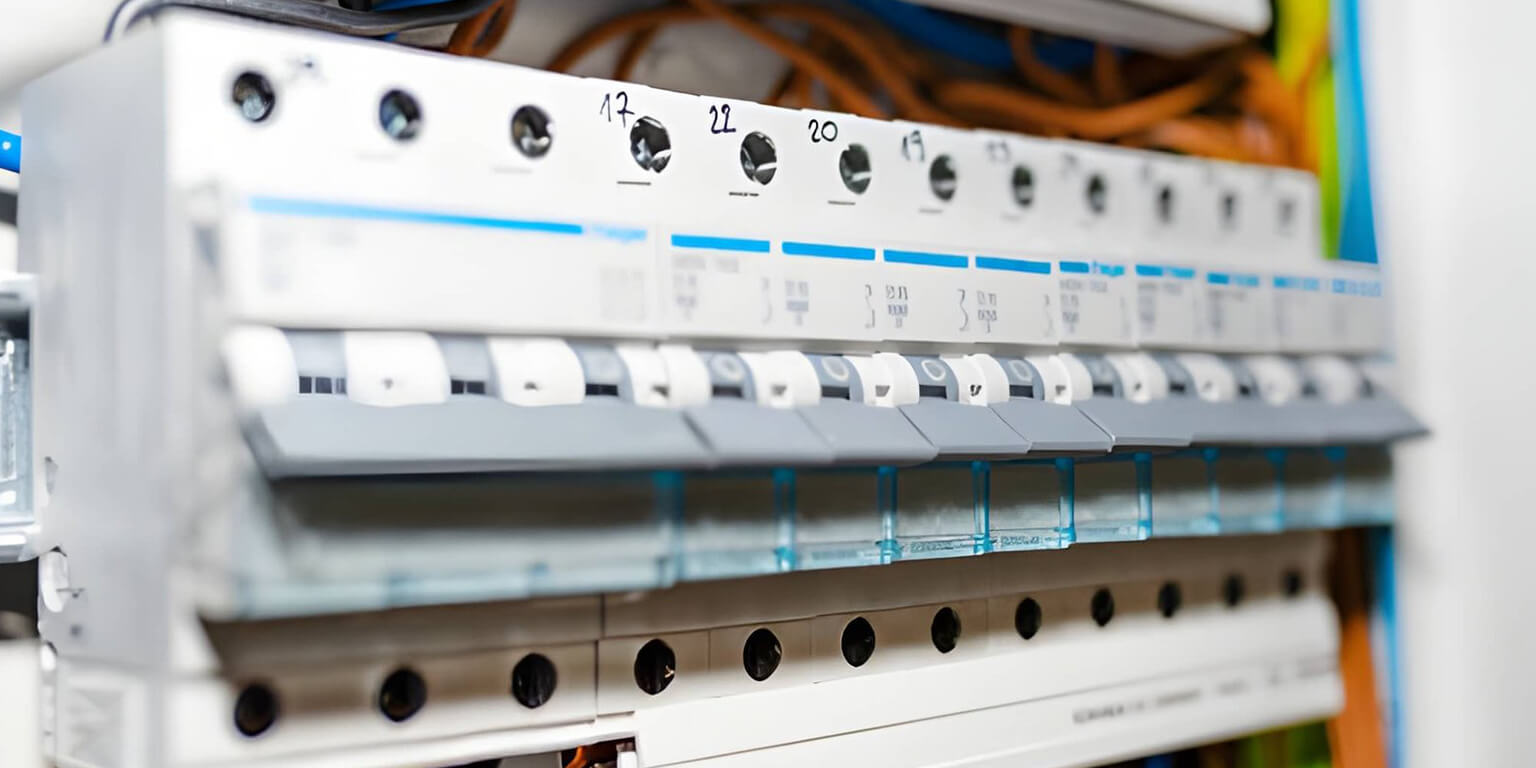
A distribution board (usually called a DB board in the UAE and GCC) is the modern standard for residential and commercial electrical systems. Inside, you'll find a main isolator switch, individual miniature circuit breakers (MCBs) for each circuit, and in most modern installations, one or more RCDs or combined RCBO units.
A distribution board is a component of an electricity supply system that divides an electrical power feed into subsidiary circuits, while providing a protective fuse or circuit breaker for each circuit, in a common enclosure. Modern boards incorporate a main switch and one or more residual-current devices (RCDs) or residual current breakers with overcurrent protection (RCBOs).
The MCBs respond to overcurrent conditions, the same function as a fuse, but faster and without needing replacement. The RCDs do something a fuse can't: they monitor the balance between current flowing out on the live wire and returning on the neutral. If they detect a difference of just a few milliamps, indicating that current is escaping through an unintended path, possibly through a person, the RCD trips the circuit in a fraction of a second. That speed is what makes the difference between a near-miss and something much worse.
The Key Differences at a Glance
Protection speed. Old fuses can degrade over time. Their reaction time to a short circuit can be slow or inconsistent. Modern breakers in a distribution board are highly sensitive, reacting almost instantly to electrical surges. This speed reduces damage to appliances and wiring.
RCD and shock protection. A fuse only protects wiring from overheating. It doesn't protect against electric shock. A modern DB board with RCD protection can cut power before a fault current reaches levels that cause serious injury.
Resettability. Breakers are reusable. Fuses aren't. And as we've already covered, human error during fuse replacement creates genuine risk.
Capacity. Older fuse panels were typically rated for lower amperage main services, often between 60 to 100 amps. Modern homes, filled with high-draw appliances like air conditioners and kitchen equipment, require higher capacity to operate safely. In Dubai, where multiple AC units can run simultaneously for months, this matters more than in most other places.
Labelling and fault diagnosis. A DB board with properly labelled breakers makes it straightforward to identify which circuit has tripped and why. An unlabelled or poorly documented fuse box makes troubleshooting significantly harder.
What Does This Mean for Properties in Dubai?
All new residential and commercial construction in Dubai is built to DEWA's Regulations for Electrical Installations, which require modern distribution boards. But there are older buildings in the city where fuse-based systems are still in place, and some of those properties haven't had a formal electrical assessment in years.
If your property has a fuse box rather than a DB board, or if you're not sure which you have, it's worth getting it assessed.
Signs that a fuse-based system may be struggling include fuses that blow repeatedly, flickering lights when large appliances switch on, outlets or the panel cover that feel warm, a burning smell near the electrical panel, or a buzzing sound coming from the fuse box. These are clear signals that the system is unsafe and that a professional inspection is needed to determine the extent of the situation and whether a full upgrade is required.
Even if you have a modern DB board, that doesn't mean it's in good condition or properly matched to your current load. Boards installed at the time of construction may not account for the AC units, home office equipment, or kitchen appliances that have been added since. We cover this in detail in our post on why household circuits become overloaded, which is often the first sign that a DB board needs to be assessed or upgraded.
When Should You Upgrade?
Not every fuse box needs immediate replacement, and not every older DB board needs to be swapped out tomorrow. A professional assessment is the right starting point before any decision is made.
Generally speaking, an upgrade is worth prioritising if:
- Your property has a fuse-based system with no RCD protection
- The panel is more than 15 to 20 years old and hasn't been inspected recently
- You're adding significant new load, such as additional AC units, a home office setup, or kitchen appliances, to a property whose wiring was sized for a lighter demand
- Fuses or breakers are tripping or blowing repeatedly
- You notice any physical signs of heat damage near the panel
Any work involving the DB board must be carried out by a DEWA-certified, licensed electrician. This isn't discretionary. In Dubai, electrical work that affects the distribution board or internal wiring must comply with applicable regulations, and unlicensed work can affect your property insurance.
Getting the Right Advice
Our guide on what happens during a professional electrical safety inspection explains what a licensed technician actually checks during an assessment, including the DB board, earthing, insulation, and circuit protection. And if you've been noticing warning signs already, our post on signs your electrical system needs maintenance is a useful first reference.
At GeeM, our DEWA-certified electricians work on distribution boards in apartments, villas, and commercial properties across Dubai. Whether it's an inspection, a DB board upgrade, or a full electrical assessment, we give you a clear picture of what your property actually needs rather than what sounds most expensive.
Our electrical services in Dubai cover fault diagnosis, panel upgrades, and ongoing maintenance. And for homeowners who want to stay ahead of these issues on a scheduled basis, our villa maintenance contracts include periodic electrical checks as part of the package.
If you're not sure whether your property has a fuse box or a modern DB board, or if you know it needs attention and want a professional opinion, get in touch with our team and we'll advise you on the right next step.
FAQ
.svg)
A fuse box uses sacrificial fuses that physically melt during an overload and must be physically replaced. A DB board uses resettable miniature circuit breakers (MCBs) that trip to the off position and can be reset with a switch. Modern DB boards also include residual current devices (RCDs) that protect against electric shock, which fuse boxes don't provide.
A fuse box that's in working order isn't necessarily dangerous in the immediate sense, but it lacks the protection features of a modern DB board, particularly RCD shock protection. It also presents risks if fuses are replaced with incorrect ratings, which can allow wiring to overheat without the fuse blowing. In Dubai, all new installations are required to use modern distribution boards.
A property with an older fuse-based system may still be operational, but it doesn't meet the standards required for new installations. If a fuse box is in a property you're renting, purchasing, or managing, an electrical inspection by a licensed professional will tell you the actual condition of the system and whether an upgrade is recommended.
Open your electrical panel. If you see a row of switches or toggle breakers that can be flipped on and off, you have a modern DB board. If you see ceramic or cartridge fuses that need to be removed and replaced when they blow, you have a fuse box. If you're unsure, a licensed electrician can confirm which system you have during an inspection.
A quality DB board, properly installed and maintained, can last for 20 to 25 years or more. That said, the board's lifespan doesn't mean it's still appropriate for your property's current load. A DB board sized for a property when it was first wired may not be adequate if you've added AC units, home office equipment, or significant appliances since then. An assessment confirms whether the board is still matched to your needs.
Any modification to a property's electrical distribution system in Dubai must comply with DEWA's Regulations for Electrical Installations and must be carried out by a DEWA-certified, licensed electrical contractor. Work on distribution boards cannot be done as a DIY project, and unlicensed work can affect your property insurance and compliance status.
Costs vary depending on the size of the property, the current condition of the wiring, the complexity of the installation, and whether any remedial wiring work is required alongside the upgrade. The most accurate way to get a figure is to have a licensed electrician assess the property and provide a specific quote based on what's actually needed.
Table of content
- Extreme Heat and Overworking
- Poor Maintenance and Dirty Filters
- Incorrect Sizing of AC Units
- Low Refrigerant Levels
Recent Posts

Download our App







© 2026 GeeM.
.svg)