














































Quick answer: Under Dubai Law No. 26 of 2007, the landlord is responsible for maintenance and for repairing defects that affect the tenant's use, unless the parties agree otherwise. The unified Ejari contract repeats that default and allows a written exception. A good contract states who handles which maintenance, how requests are made, and who holds the annual maintenance contract (AMC).
This guide is for landlords, tenants and property managers who want the maintenance clause in a Dubai tenancy contract to be clear before anyone signs. It quotes only the official texts linked below.
This article is general information, not legal advice. For a specific dispute or contract, read the official texts and take advice from a qualified professional.
What Dubai law says a tenancy contract starts from
The legal starting point is Article 16 of Law No. 26 of 2007: unless the parties agree otherwise, the landlord is responsible for the property's maintenance works and for repairing any defect or damage that may affect the tenant's intended use.
The official English text of Law No. 26 of 2007 regulates the relationship between landlords and tenants in Dubai. Three words in Article 16 matter most for the contract: "unless otherwise agreed." The law sets a default, and the parties can change it in their agreement. Clause 12 of the unified Ejari contract adds that any additional condition is not considered if it conflicts with the law.
Article 15 adds that the landlord must hand over the property "in good condition, which allows the Tenant full use stated in the Lease Contract."
For a fuller breakdown of who pays for which repair, read our guide to landlord and tenant maintenance responsibilities in Dubai. This article focuses on what to write in the contract itself.
What the unified Ejari contract already says about maintenance
The unified Ejari tenancy contract sets the landlord's maintenance duty in Clause 8: the landlord does "the regular maintenance as intended unless other condition agreed in written." Any different arrangement has to be written into the contract.
The unified tenancy contract published by the Dubai Land Department (DLD) is the standard form used for Ejari registration. You can download it from the DLD Ejari templates page. The clauses most relevant to maintenance are:
- Clause 8: the landlord undertakes to enable the tenant's full use of the premises, including facilities such as a swimming pool, gym or parking, and to do "the regular maintenance as intended unless other condition agreed in written."
- Clause 3: the tenant may not make amendments or modifications to the premises without the landlord's written approval, and "shall be liable for any damages or failure due to that."
- Clause 4: the tenant pays electricity, water, cooling and gas charges from occupying the unit, "unless other condition agreed in written."
- Clause 11: the contract is subject to Law No. 26 of 2007, as amended.
- Clause 12: "Any additional condition will not be considered in case it conflicts with law."
The form does not list minor versus major repairs, set a cost threshold or define access arrangements for maintenance visits. If you want any of those, you add them in writing.
What Articles 15 to 21 mean for the maintenance clause
Read with the contract, Law No. 26 sets the default your clause starts from: the landlord handles maintenance and defects not caused by the tenant (Articles 16 and 17), and the tenant looks after the property as an ordinary person would and carries out no works without permission (Article 19).
Here is the split as the official text of Law No. 26 states it:
| Article | What it says |
|---|---|
| Art. 15 | The landlord hands over the property in good condition for the use stated in the contract. |
| Art. 16 | Unless otherwise agreed, the landlord is responsible for maintenance works and for repairing defects or damage that affect the tenant's intended use. |
| Art. 17 | The landlord is responsible for any defect, damage, deficiency, and wear and tear "for reasons not attributable to the fault of the Tenant." |
| Art. 19 | The tenant must maintain the property "in such a manner as an ordinary person would maintain his own property", and may not carry out changes, restoration or maintenance works unless the landlord permits them and the required licences are obtained. |
| Art. 20 | The landlord may take a security deposit "to ensure maintenance of the Real Property upon the expiry of the Lease Contract", and must refund it or the remainder. |
| Art. 21 | On expiry, the tenant returns the property in the condition received, except for ordinary wear and tear or damage beyond the tenant's control. |
What the law text does not say. The official text does not set a cost threshold below which the tenant pays for repairs. You may see a figure like that in some contracts or articles. It is a contract term, and it applies only if the signed contract states it. The text also does not set a notice period for maintenance visits, and it does not say a tenant may deduct repair costs from rent.
For the AC question specifically, see who pays for AC repair in Dubai.
What to write in the maintenance clause before anyone signs
A useful maintenance clause, added in writing to the unified contract, names who is responsible for each type of in-unit work, states any cost threshold as an exact contract figure, names who holds the AMC, and sets how requests and access are handled.
The DLD Tenancy Guide supports this approach. In its registration checklist for owners who lease and manage their property themselves, item 11 says: "The party responsible for maintenance shall be identified and a maintenance contract shall be procured from a building maintenance company."
Points to cover in the clause:
- Who is responsible for maintenance works and for defects that affect the intended use. If you keep the Article 16 default, say so. If you change it, say exactly how.
- What ordinary tenant upkeep means for this unit, if you want to spell out Article 19. For example, replacing light bulbs or keeping drains clear.
- Any cost threshold. If you use one, write the exact figure and what happens above it. It is a contract term, not a legal default.
- Who arranges and pays for the in-unit AMC, and who calls the AMC provider when something breaks.
- Access for maintenance. How visits are booked, and what happens if a visit cannot go ahead.
- Written requests and approvals. Repairs requested and approved in writing, including any works by the tenant (Clause 3 and Article 19).
- Building service charges are separate from in-unit work.
- Disputes go to the Rental Disputes Centre, as Clause 10 of the unified contract states.
Keep the wording plain and specific. Avoid copying sample wording from the internet into a signed contract without checking it against the official texts.
In-unit repairs are not building service charges
Building service charges pay for the common parts of a development, such as lifts, lobbies and shared plant. In-unit maintenance covers the systems inside the apartment, such as the AC, plumbing, water heater and electrics. They are different bills.
In a typical Dubai apartment, the owner pays the service charge to the owners association, while maintenance inside the unit follows the tenancy contract. Writing that distinction into the clause prevents a common argument, where a tenant assumes the service charge covers their AC or the landlord assumes it does.
For a full explanation, read our guide to apartment AMC vs service charges in Dubai.
How an apartment AMC makes the clause work
Once the clause says who is responsible for in-unit maintenance, an annual maintenance contract is how that party actually delivers it: scheduled servicing plus call-outs from one provider, with a record of every visit. Landlords often hold the AMC, but the right holder is whoever the clause names.
An apartment annual maintenance contract (AMC) is a yearly agreement in which a maintenance company services the unit's AC, plumbing and electrics on a schedule and handles breakdowns between visits.
An apartment maintenance contract in Dubai gives both sides something to point to:
- For landlords: a documented service history, which helps show the property is maintained under Articles 15 to 17 and makes condition checks at the end of the tenancy easier.
- For tenants: one number to call, with no need to chase the landlord for every leak or AC fault.
- For both: visit reports that show what was found and fixed, which removes most of the "who caused this?" debate.
GeeM's apartment AMCs include unlimited call-outs with labour included, and GeeM's First-Time Fix applies. Plans are quoted by property size. Our guides to AMCs for landlords and AMCs for tenants cover each side's view.
What advertised apartment AMC prices usually include, and what "from" figures leave out
Advertised apartment AMC prices in Dubai usually describe the smallest unit, often a studio or one-bedroom, with core AC, plumbing and electrical cover. Extra AC units, parts, duct cleaning and pest control are commonly outside the "from" price.
Across public apartment AMC pages checked on 19 November 2026, plans usually come in two to five tiers. Common patterns:
- Usually included: scheduled AC or fan-coil servicing, plumbing and electrical checks, labour on covered call-outs and a visit report.
- Usually outside the "from" price: larger units and extra AC units, major parts such as compressors, motors and heaters, appliances, duct cleaning, pest control, and anything in the building's common parts.
- Call-outs: some plans cap them, while upper tiers often say "unlimited", usually meaning labour on listed trades, not parts.
- VAT: some prices include VAT and some do not. Ask for the VAT-inclusive total.
Before you sign any AMC, check the parts and exclusions wording with our pre-signing AMC checklist and see what is included in an AMC.
If you cannot agree, where the dispute goes
Rental disputes in Dubai go to the Rental Disputes Centre (RDC). Clause 10 of the unified contract says disputes "shall be settled by the Rental Dispute Center", and Article 21 of Law No. 26 refers end-of-tenancy condition disputes to the Tribunal.
The RDC's current portal is rdc.gov.ae. Its services have moved from the DLD website, so older references to the DLD site for disputes now point there.
Practical steps that keep a dispute simple:
- Put maintenance requests and approvals in writing.
- Keep visit reports and photos of the issue and the repair.
- Check what the signed contract says before deciding who pays.
The official pages checked for this article do not set out a process for deducting repair costs from rent, so do not rely on one.
The fair fix: write the clause, then put an AMC behind it
Most landlord and tenant maintenance arguments come from an unclear clause and no maintenance record. A clear written clause plus an in-unit AMC fixes both. It is a fair, predictable way to keep the unit maintained without arguing about blame.
With an AMC, scheduled servicing happens whether or not anyone remembers, breakdowns go to one provider, and every visit leaves a report. The clause decides who holds the contract, and the AMC removes the guesswork about what happened and when.
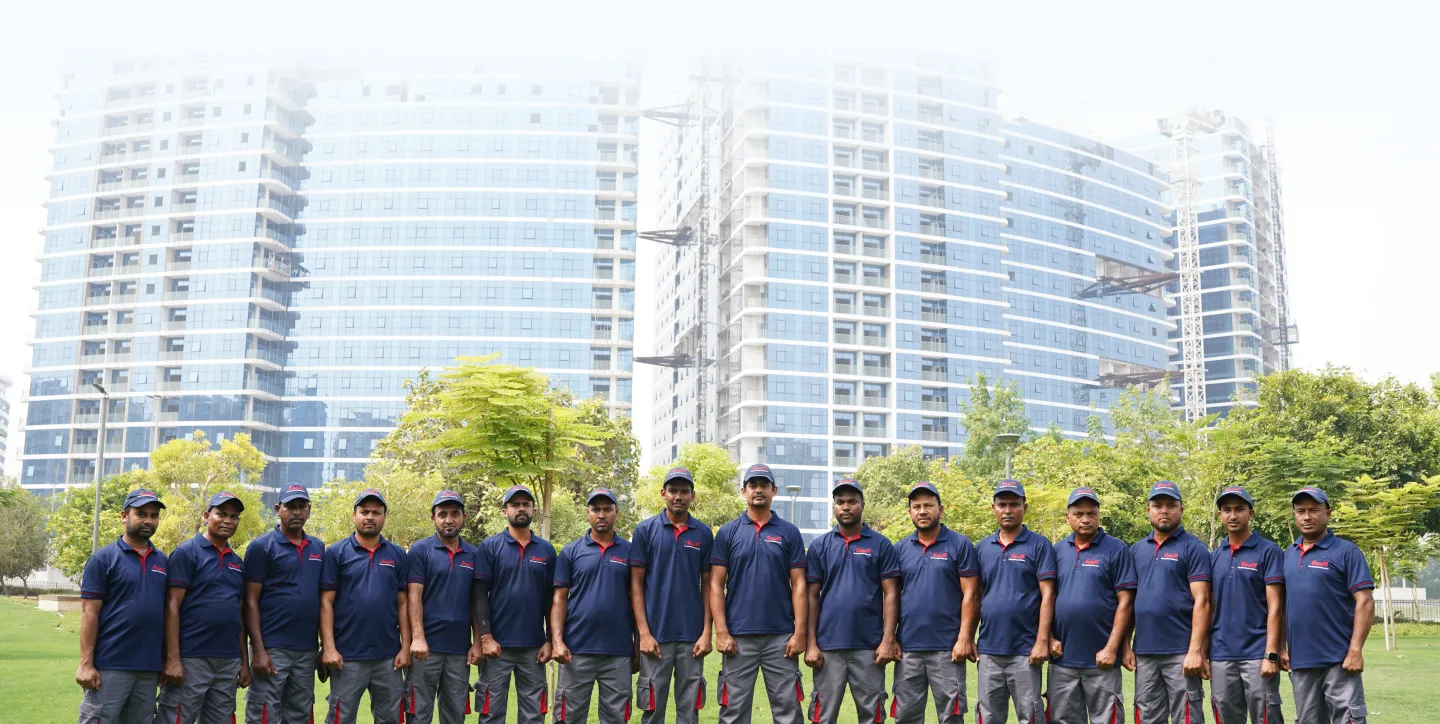
GeeM has been maintaining Dubai homes since 2004, with 50+ technicians, 20+ vehicles, 25k+ jobs completed and 15k+ happy clients. We are insured and UCS-GAC certified, and pest control is available as an add-on.
Get an apartment AMC quote, explore all our annual maintenance contracts, or call 8004336.
Official texts checked 19 November 2026. This article is general information, not legal advice.