Dubai Real Estate Boom 2026: What Owning Property in a Record Market Really Costs You

Post Details
The Boom Is Real — Here's What the Data Says
Let's be clear: the numbers are not exaggerated. According to DXB Interact's latest market data, Dubai's residential market recorded 30,220 transactions — a 40% surge year-on-year. The median price per square foot now sits at AED 1,870, up 14% from the same period last year, and the median property price has crossed AED 2,016,000 — a 9% annual increase. These are not projections. They are completed transactions.
The momentum is visible at every price point. On a single Tuesday at the end of March 2026, Dubai real estate recorded AED 3.57 billion in total transactions through 1,178 deals in a single day — including luxury apartment sales in Armani Beach Residences on Palm Jumeirah at AED 48.96 million, and a resale at Bluewaters Residences for AED 90 million.
Record Deals That Signal Where the Market Is Heading
At the very top of the market, a Burj Khalifa duplex penthouse on floors 87 and 88 was leased for AED 12 million per year — the highest annual apartment rental ever recorded in the UAE. Trophy assets are not just holding value; they are commanding prices that reflect an entirely new tier of confidence in Dubai as a long-term wealth address.
Post-holiday activity confirmed that the market's engine hasn't stalled. In the week following Eid Al Fitr, Dubai property transactions rebounded 49%, reaching AED 8.66 billion — with off-plan apartments accounting for over 77% of that volume, driven overwhelmingly by cash purchases.
The Nuance: What the Mid-March Slowdown Tells Us
The picture has nuance, and serious property owners should understand it. In the first twelve days of March, real estate transaction volumes in the UAE fell 37% year-on-year, coinciding with regional geopolitical tensions. Some agents reported price reductions of 12–15% on certain properties, and analyst firms flagged the period as a stress test for Dubai's safe-haven narrative.
Here's the real reading: the market paused, tested itself, and bounced back sharply. Analysts at Goldman Sachs noted transaction volumes recovered; Emaar founder Mohamed Alabbar described owners as unwilling to budge on price. This is what a mature, fundamentally sound market looks like under pressure. It doesn't collapse. It corrects, and it continues.
The Upfront Costs Most Buyers Underestimate
Most buyers focus on the property price. The experienced ones budget for what comes immediately after the sale is agreed. In Dubai's current market, where the median transaction is over AED 2 million, these upfront costs are substantial and non-negotiable.
The Government Layer: DLD Fees and Registration
Every property purchase in Dubai carries a mandatory 4% Dubai Land Department (DLD) transfer fee on the purchase price. On a AED 2,016,000 property — today's median — that is AED 80,640 in government fees before a single other cost is paid. Add administrative charges of approximately AED 4,700–5,500 for registration, title deed issuance, and trustee office fees, and the government layer alone approaches AED 86,000 on a median-priced purchase.
The Transaction Layer: Agents, Conveyancing and Mortgage Fees
If you purchased through an agent — which most buyers in the secondary market do — expect a 2% commission plus 5% VAT on the purchase price. On a AED 2M property, that adds AED 42,000. Conveyancing fees for legal review and title verification typically run AED 6,000–10,000. If you financed the purchase, add a mortgage registration fee of 0.25% of the loan amount, plus bank arrangement fees of up to 1% of the loan value and a property valuation fee of AED 2,500–3,500.
The Activation Layer: DEWA, Cooling and Utility Connections
Once ownership transfers, the property must be activated. DEWA connection and security deposits typically run AED 2,000–4,000 depending on unit type. Properties in district cooling zones — Downtown Dubai, Dubai Marina, Business Bay — require an additional chiller connection deposit of AED 1,000–2,500. These are upfront costs that arrive before you've spent a dirham on furniture or maintenance.
The Ongoing Costs That Never Stop
Here's what most property guides don't tell you: in Dubai, the costs of ownership don't end at the purchase. They begin there. Service charges, utilities, and insurance are recurring expenses that arrive every year — whether your property is occupied or vacant.
Service Charges: What You Pay Regardless
Every property owner in Dubai pays annual service charges governed by the RERA service charge index and collected through the official Mollak system. These cover common area maintenance, security, landscaping, elevators, and shared facilities. They are non-negotiable — even for vacant units.
The variation is significant. Apartment service charges range from AED 10 to AED 30 per square foot annually in most areas, with premium locations commanding far more. Downtown Dubai's Burj Khalifa district averages AED 67.88 per sqft — meaning a 1,200 sqft apartment carries service charges of over AED 81,000 per year before a single utility bill is paid. In Dubai Marina, expect AED 14–28/sqft. Villa communities are lower, typically AED 2–6/sqft, though villa owners carry full responsibility for private external and internal maintenance themselves.
Utility Bills: The Permanent Overhead
DEWA charges are consumption-based, but Dubai's climate ensures they are consistently significant. A standard three-bedroom villa in Dubai averages AED 30,000 annually in DEWA costs alone, including electricity, water, and the 5% housing fee applied to utility bills. Air conditioning is not a seasonal luxury here — it is infrastructure, and its energy consumption defines your DEWA bill across all twelve months of the year.
Property Insurance: What You Need and What It Costs
While not legally mandatory for cash buyers, property insurance is strongly recommended — and required by banks for mortgaged properties. Basic building coverage for a villa valued at AED 3.5 million runs approximately AED 1,500–2,000 per year. Comprehensive home and contents insurance ranges from AED 2,500–5,000 annually. These are modest costs relative to the asset value, and they represent the minimum financial protection any serious property owner should carry.
The Cost Most Property Owners Don't Budget For
Upfront costs are visible. Service charges arrive as invoices. But the cost that consistently surprises Dubai property owners — and consistently erodes their returns — is the one they can control most directly: internal maintenance.
Why Dubai's Climate Makes This Non-Negotiable
Dubai's operating environment is genuinely demanding on residential infrastructure. Summer temperatures sustained above 45°C push AC systems to continuous maximum load for months. The combination of humidity, dust, hard water, and temperature extremes accelerates wear on plumbing, electrical systems, and HVAC components at a rate that most temperate-climate property owners simply don't anticipate.
A single summer without proper AC servicing doesn't just reduce comfort — it risks compressor failure, refrigerant leaks, and blocked drainage that can cause water damage. Unchecked plumbing in Dubai's hard-water environment leads to scale buildup, pressure loss, and pipe corrosion. Electrical systems under sustained cooling loads need regular inspection to remain compliant and safe. These are not theoretical risks. They are the predictable outcomes of reactive maintenance in a demanding climate.
The Real Cost: Reactive vs. Preventative Maintenance
Here's the reality that every property owner in a rising market should understand. Maintaining a standard three-bedroom villa in Dubai costs an average of AED 70,000–100,000 per year when all systems are properly serviced. That figure represents roughly 2% of the property's value annually — a number consistent with well-managed residential assets globally.
Reactive maintenance — waiting for something to fail before calling a technician — reliably costs more. Emergency call-outs carry premium pricing. Damage from delayed repairs compounds. Tenants leave properties where systems are unreliable, and vacant periods erode rental yield. In a market where analysts project 5–8% annual price appreciation going forward, losing a tenant due to a failed AC system or a persistent plumbing issue is not a minor inconvenience. It is a measurable financial loss.
What an Annual Maintenance Contract Covers — and What It Saves
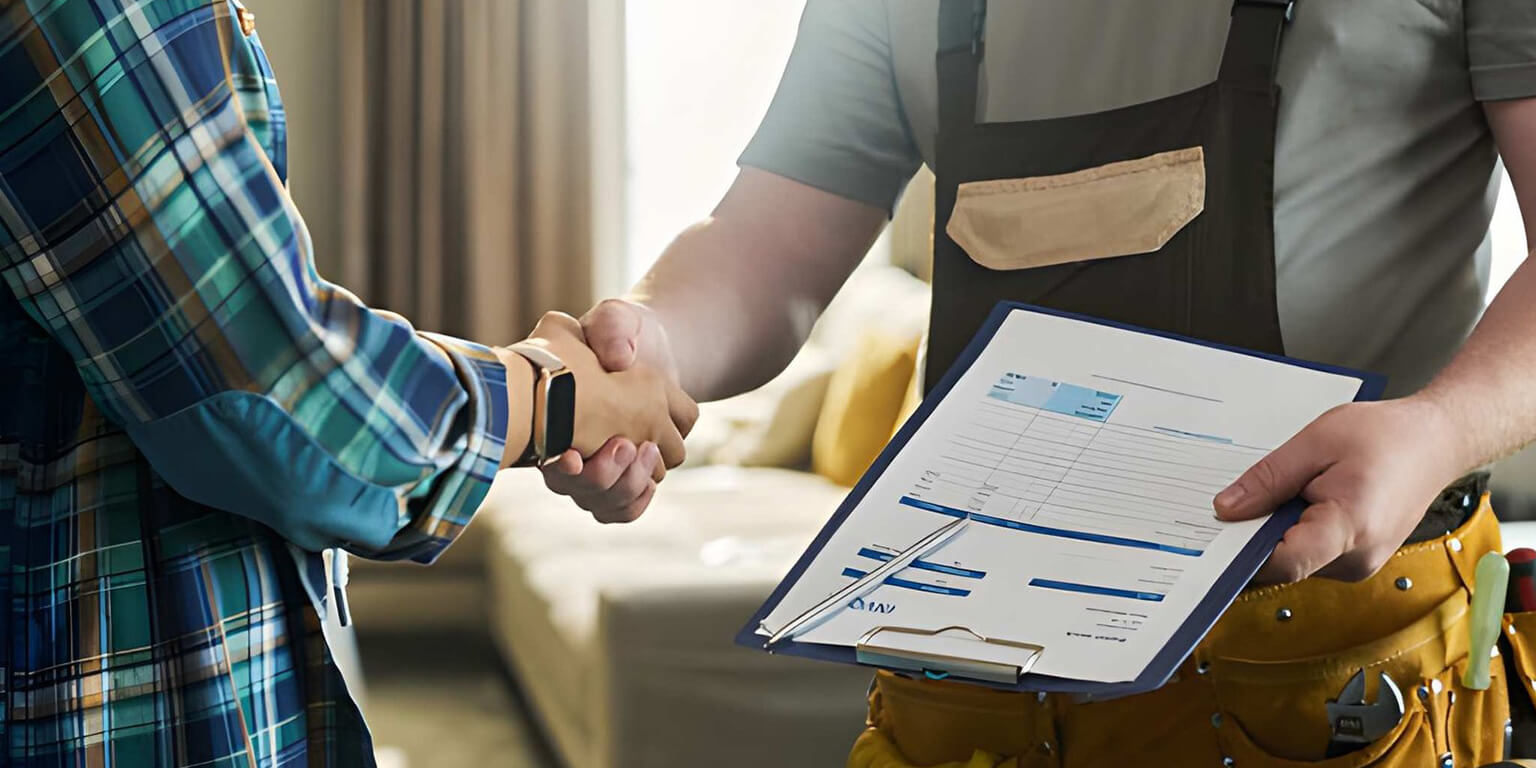
An annual maintenance contract in Dubai is not an administrative expense. It is the operational framework that separates properties that perform from properties that drain their owners. A structured AMC typically covers scheduled AC servicing and cleaning, plumbing inspections and reactive repairs, electrical system checks, and 24/7 emergency response — removing the friction of finding qualified technicians under pressure.
For owners of villas in Dubai, where the full scope of maintenance responsibility falls on the owner, an AMC is particularly critical. Unlike apartment owners who share common area costs through service charges, villa owners are entirely responsible for their AC systems, plumbing infrastructure, electrical boards, pools, and external fabric. An unmanaged villa in Dubai's climate will show its age quickly — and age visibly affects resale value in a competitive market.
For apartment owners in Dubai, an AMC covers the interior systems that service charges do not: the split AC units within your unit, your internal plumbing, electrical outlets and circuit boards, and in-unit appliances. These are your responsibility as an owner — not the building management's — and their condition directly affects both tenant satisfaction and resale readiness.
The practical conclusion: budget 8–10% of property value for upfront costs, and plan for 3–5% of property value annually in ongoing ownership expenses. These are not worst-case figures — they reflect the real operating cost of a well-managed property in today's Dubai market.
How to Budget as an International Owner
International owners face one additional layer of complexity: distance. When a system fails at 11pm in July and you are in London, Karachi, or Lagos, the quality of your maintenance relationship is everything. The owners who manage Dubai properties successfully from abroad share a common practice — they establish a trusted maintenance partnership before something goes wrong, not after. A structured annual maintenance contract covering AC, electrical and plumbing removes the most common and costly failure points from the equation entirely.
Will the Market Keep Rising — And Does It Change Your Maintenance Calculus?
What analysts say about 2026 price trajectory
The consensus among major research houses points to continued appreciation — at a more measured pace. Knight Frank anticipates price growth of approximately 3% in the prime segment, while Cushman & Wakefield Core forecast 5–8% appreciation across the broader market in 2026 — a deliberate moderation from the 12–22% annual gains recorded in 2024–2025. This is what market maturation looks like: sustainable growth, not speculative acceleration.
The supply context matters here. With approximately 120,000 new residential units projected for handover in Dubai during 2026, buyers will have more choice than they did in 2024. In that environment, the quality and condition of a property directly affects both its rental performance and its resale trajectory. A well-maintained property commands higher rent, attracts better tenants, and sells faster. A property that has been managed reactively will face price resistance it didn't encounter two years ago.
Why a maturing market rewards well-maintained properties more than ever
Here's the shift that owners should understand: in an appreciating market with limited supply, almost any property performs. In a maturing market with expanding inventory, quality differentiates. A functioning, serviced, well-presented property is no longer just better than average — it is strategically positioned. Tenants and buyers in 2026 have options. They will choose the property where the AC is serviced, the plumbing is reliable, and the electrical system is current.
The real estate boom gives your property its value. Proper maintenance is what protects and sustains it.
Table of content
- Extreme Heat and Overworking
- Poor Maintenance and Dirty Filters
- Incorrect Sizing of AC Units
- Low Refrigerant Levels
Recent Posts

Download our App







© 2026 GeeM.
.svg)