


























Key Takeaways
- An owners association AMC covers the shared building systems paid for through service charges: central AC, pumps, tanks, electrical rooms, common-area lighting, drainage and general repairs in lobbies, corridors, car parks and amenities.
- Under Dubai Law No. 6 of 2019, a management entity runs and maintains common parts, while the owners committee checks that it’s done properly.
- Maintenance and supplier contracts for jointly owned buildings sit within the RERA framework, and Mollak requires management companies to upload them.
- Specialist systems such as fire safety and lifts usually need their own certified contractors alongside the AMC.
- A good contract is measured by clear scope, response priorities and monthly reporting, not just the price.
What Should an Owners Association AMC Cover?
An AMC for an owners association or building management in Dubai should cover the planned and reactive maintenance of a building’s common parts: central or shared AC, water pumps and tanks, electrical rooms and distribution boards, common-area lighting and emergency lighting, drainage, car parks, amenities and general repairs. It should also set response priorities and produce regular reports the owners committee can review.
That’s what the contract does. The harder part is getting it right.
A residential tower in Dubai Marina, a mid-rise block in JVC and a mixed-use building in Business Bay all share the same legal structure for common areas. But their plant, their age and their pressure points differ a lot. A contract written as a generic template tends to leave gaps exactly where the expensive problems sit: pump rooms, rooftop plant and the bits of the building residents only notice when they fail.
We’ve written this for owners committee members, management company staff and building managers who need to scope, compare or review a maintenance contract.
Who Is Responsible for Common Areas in Dubai?
Dubai’s Law No. 6 of 2019 on jointly owned real property sets out who manages and maintains the common parts of a building or community.
The owners committee doesn’t do the maintenance itself. Under Article 24, its role includes verifying that the management entity carries out the management, operation, maintenance and repair of the common parts. Owners fund that work through annual service charges, shared by unit area, and the law says management entities can’t collect charges without RERA approval.
In practice, that means the AMC contractor usually works for the management company, but the owners committee is the one asking whether the money is being well spent.
Where Mollak fits in
Mollak is the Dubai Land Department’s system for jointly owned properties, run through RERA. According to the Mollak service description, it handles service charge budget approvals and requires management companies to upload financial statements and copies of maintenance and supplier contracts.
So a building AMC isn’t a private arrangement tucked away in a drawer. It’s part of the record that supports the service charge budget. That’s one more reason for a clear, well-written scope.
What the AMC Should Include
Here’s the core scope we’d expect for a typical residential or mixed-use building. Your building’s plant list will add to it, and our common area maintenance service shows how we handle lobbies, corridors and shared spaces day to day.
Water systems need particular attention
Shared water systems are where compliance matters most. Dubai Municipality’s technical guidelines for Legionella control in water systems apply to residential and commercial buildings, among others. For the systems they cover, they set requirements including:
- Storage tanks inspected at least monthly, and cleaned and disinfected at least twice a year
- Hot water stored at 60°C or more where central hot water is used
- Cooling towers and similar cooling systems cleaned and disinfected at least every six months
- A risk assessment reviewed at least once a year, with records available for Dubai Municipality inspection
Your AMC should make clear who handles each item, and who holds the records.
What Usually Sits Outside the AMC
Several systems in a building need certified specialists. The AMC contractor can coordinate access and handle the building-side repairs, but shouldn’t be doing certified work it isn’t approved for.
Spell these out in the contract. The worst arguments happen when a pump room floods and the AMC contractor, the fire contractor and the building manager each assume someone else was looking after the sump pump.
Planned Maintenance: What a Good Schedule Looks Like
Most building AMCs combine planned preventive maintenance with reactive call-outs. On our building contracts, standard plans typically include two to four scheduled visits a year, while advanced plans move to monthly inspections and ongoing monitoring. Larger buildings with complex plant usually need the monthly approach, at least for pumps and electrical rooms.
A sensible schedule for a mid-sized residential tower might look like this:
That last line is worth emphasising. A yearly condition report gives the owners committee and management company evidence for the next budget cycle, so major replacements are planned rather than paid for as emergencies.
How to Compare AMC Proposals
When a building goes out to tender, proposals can look similar on the surface. These are the questions that separate them.
- Is the scope based on a site survey? A proposal written without walking the plant rooms is a guess.
- Is there an asset register? Every pump, board, AHU and tank should be listed, so nothing falls between contracts.
- What are the response priorities? Ask how critical faults such as pump failures, power outages or major leaks are prioritised compared with routine requests.
- What’s included and what’s extra? Spare parts, materials, specialist works and after-hours visits are common grey areas.
- How is work reported? Ask for a sample monthly report. It should show planned tasks completed, reactive jobs, open issues and recommendations.
- Who’s the point of contact? A named AMC manager who knows the building is worth more than a general call centre.
- How are resident-facing jobs handled? Work in lobbies, lift lobbies and corridors should be scheduled and communicated so residents aren’t caught by surprise.
For a broader view of where an AMC ends and full building management begins, our article on what a service charge doesn’t cover compared with an AMC explains the split from a resident’s perspective.
Common Areas and Individual Units
One practical point trips up a lot of buildings.
The owners association AMC covers common parts. It doesn’t cover the inside of individual apartments, where AC units, water heaters, plumbing fixtures and internal electrics are the unit owner’s responsibility, or the tenant’s under their lease. Residents often don’t know this and expect building maintenance to fix in-unit problems.
Clear communication helps. A short note from the building manager explaining what the service charge covers, and what it doesn’t, saves a lot of complaints. Our guide to Dubai property maintenance laws sets out the responsibilities in more detail.
How We Work With Building Managers and Owners Committees
We start with a site assessment of the building’s plant and common areas, then build a contract around its systems, age and operating needs, rather than a fixed template. Scheduled preventive inspections follow, with a report after every service visit, so the management company and owners committee can see exactly what’s been done.
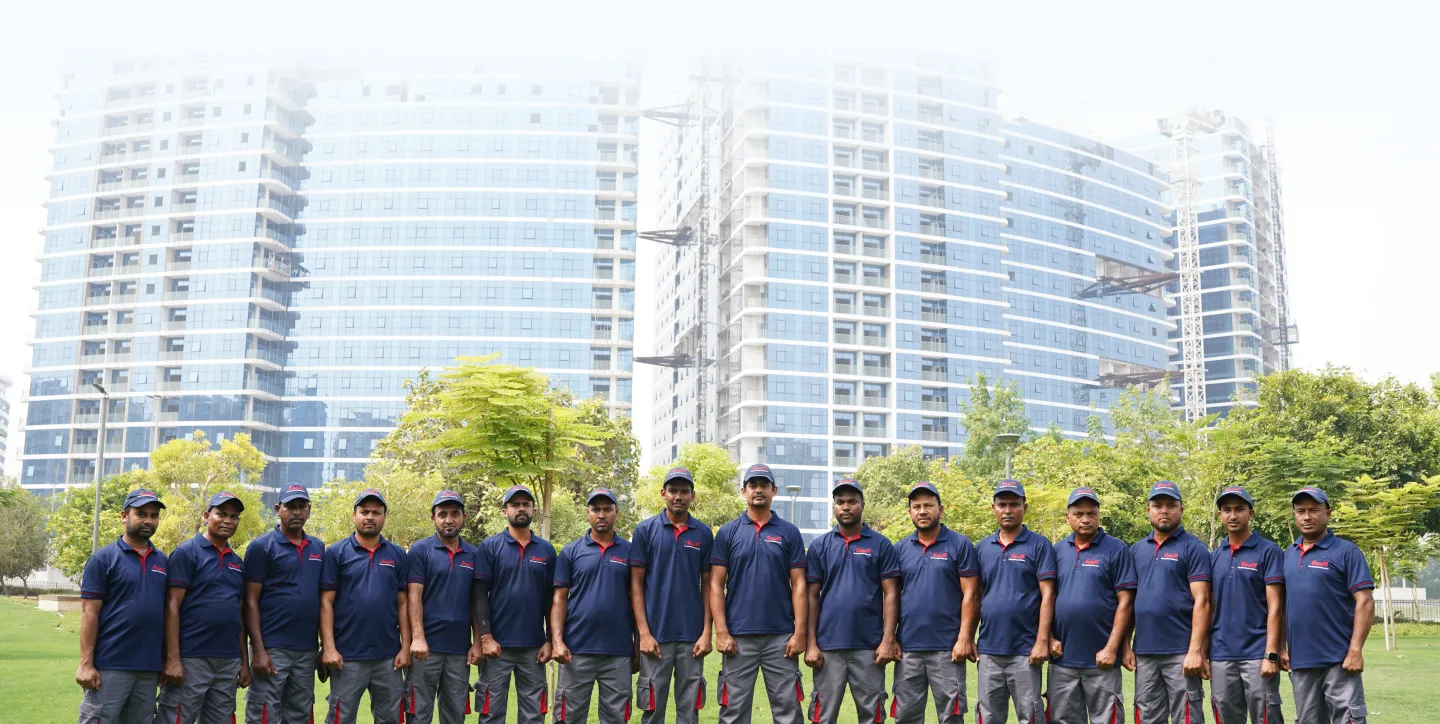
Our team covers AC, electrical, plumbing, pumps, preventive maintenance and general repairs, with emergency support for urgent faults. We bring over 20 years of maintenance work in Dubai, 50-plus technicians and DEWA-registered electricians, and we work alongside the building’s fire, lift and other specialist contractors rather than in place of them.
You can see how our building AMC contracts in Dubai are structured, or request a building maintenance proposal from GeeM. You can also call us on 800 4336.
Disclaimer: This article is general information for owners committees, management companies and building managers. It isn’t legal or engineering advice. Requirements under Dubai Law No. 6 of 2019, RERA, Dubai Municipality and Dubai Civil Defence can change and depend on each building’s status, so confirm specifics with the relevant authority or a qualified adviser. Electrical, plumbing, fire and lift work should only be carried out by appropriately licensed professionals.